论文
2026
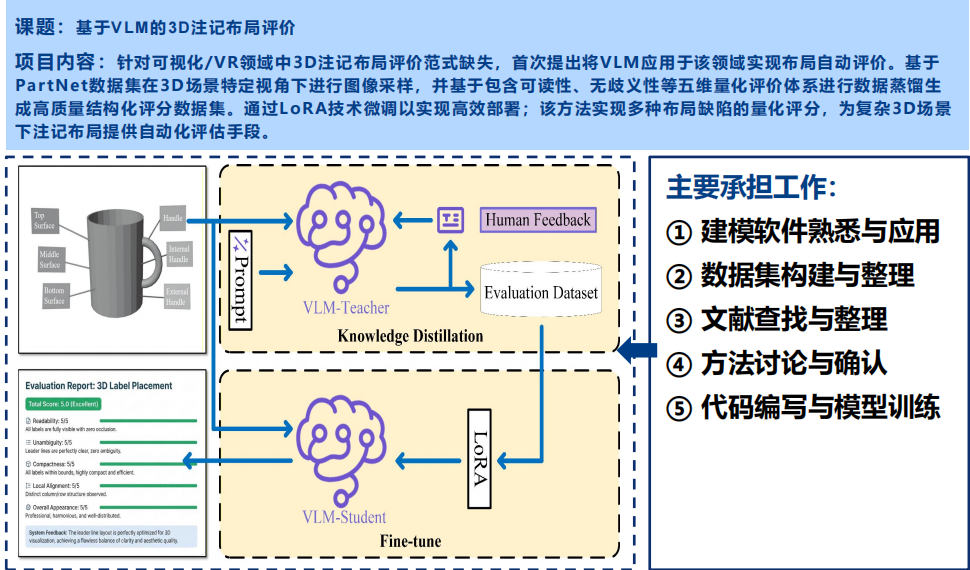
- In ProgressMLLM-based Evaluation of 3D Annotation LayoutsHongyi Yang and Jingwei Qu*In , 2026Ongoing research project
Addressing the lack of 3D annotation layout evaluation paradigms in visualization and VR domains, we propose for the first time applying Multimodal Large Language Models (MLLMs) to this field for automatic layout evaluation. Based on the PartNet dataset, we construct a dataset with annotation layouts in 3D scenes, formulate a quantitative evaluation system comprising readability, unambiguity, compactness, alignment, and aesthetics, and utilize knowledge distillation to generate a structured scoring dataset. We fine-tune lightweight models via LoRA technology to achieve efficient deployment. This method achieves accurate identification and quantitative scoring of various layout defects such as label occlusion and leader line intersection, providing a robust foundation for annotation layout evaluation in complex 3D scenes.
Intro: MLLM-based Evaluation of 3D Annotation Layouts
2025
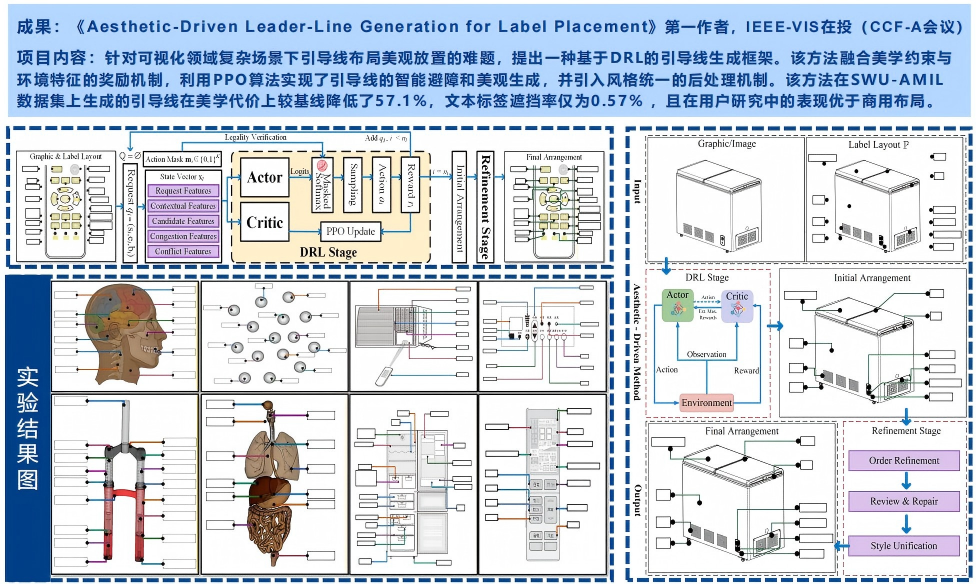
- TVCGDRL-Driven Leader-Line Generation for Label LayoutHongyi Yang, Ronghua Liu, Yadong Gu, Bingyao Huang, Haibin Ling, and Jingwei Qu*In , 2025IEEE-VIS TVCG fast track (CCF-A)
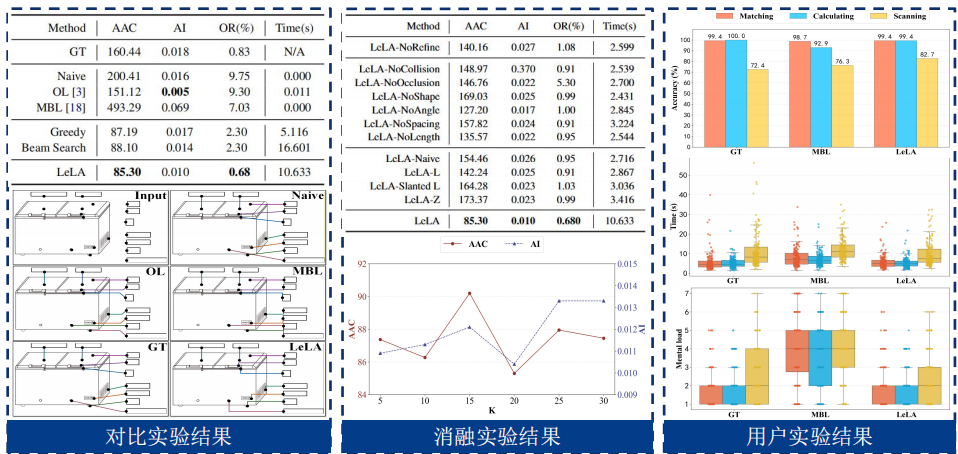
In view management, mainstream work focuses on label placement issues, while the clear generation of leader lines as visual bridges remains underexplored. This work achieves leader line layout generation in complex scenes and proposes a leader line generation framework based on deep reinforcement learning. By utilizing the PPO algorithm, intelligent obstacle avoidance and dynamic generation of leader lines are achieved, and a unified-style post-processing mechanism is introduced to ensure visual consistency of the overall layout. Experiments show that this method improves layout clarity by 5.71% over baselines on the SWU-AMIL dataset, achieves a text-label occlusion rate of only 0.07%, and outperforms commercial layouts in user studies.
Intro: DRL-Driven Leader-Line Generation for Label Layout
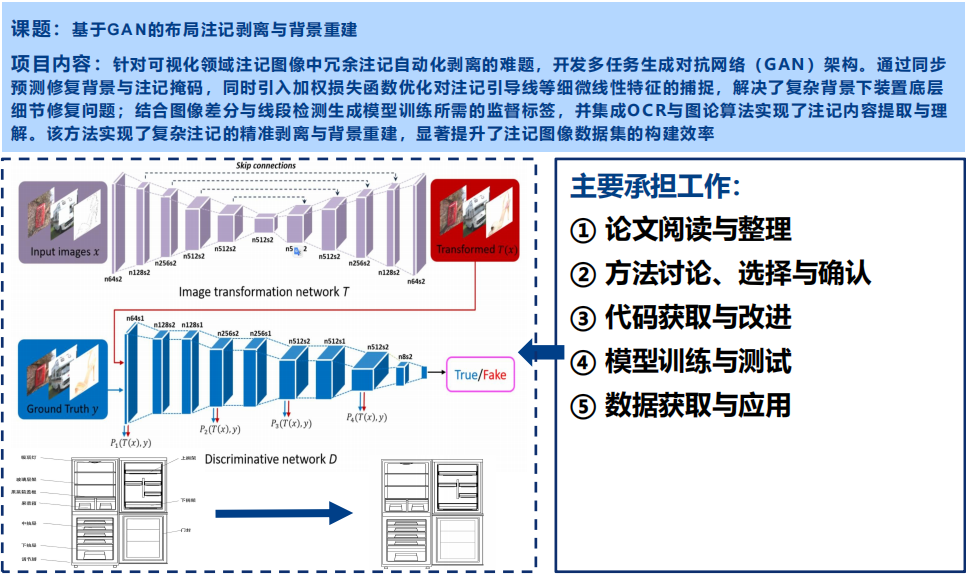
- CompletedGAN-based Annotation Stripping and Background ReconstructionHongyi Yang and Jingwei Qu*In , 2025Completed research project (2024.12 - 2025.07)
Addressing the challenge of stripping annotations from images with annotation layouts, we synchronously predict background inpainting and annotation masks based on GANs. Concurrently, a weighted loss function is introduced to optimize the capture of subtle linear features such as annotation leader lines, resolving the high-fidelity inpainting problem of underlying equipment details under complex backgrounds. By combining image differencing and line segment detection, the supervision labels required for model training are automatically generated, and OCR and graph theory algorithms are integrated to achieve the extraction and understanding of annotation content. This method achieves accurate stripping of complex annotations and background reconstruction, significantly improving the construction efficiency of structured image datasets.
Intro: GAN-based Annotation Stripping and Background Reconstruction